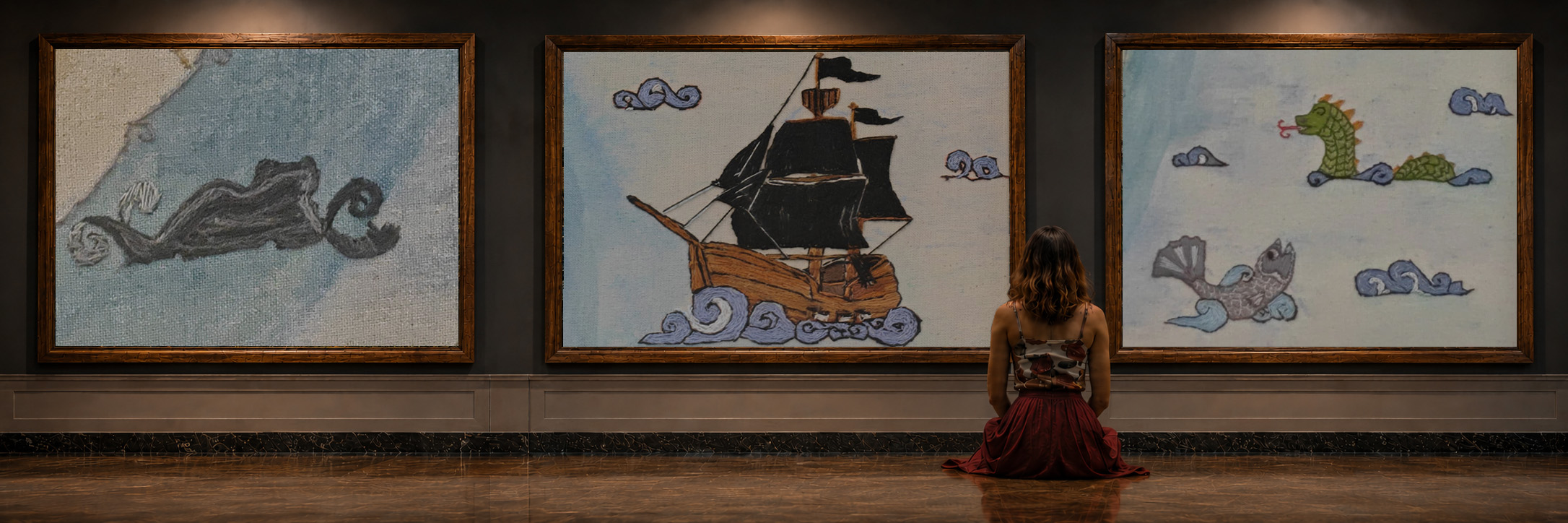
Voyage of Hope is a moving community tapestry project that tells the story of the sixteen young women who left Dunshaughlin Workhouse in 1849 to begin a new life in Australia under the Earl Grey Assisted Emigration Scheme. Through detailed historical research, original artwork and traditional embroidery, Threads of Lore is preserving this remarkable chapter of local history, honouring the courage, resilience and hope of those who embarked on a life-changing journey across the world.
Voyage of Hope Tapestry Launch
The Girls Behind the Voyage of Hope
The Story of the Voyage of Hope
Between 1848 and 1850, more than 4,000 girls travelled from Ireland to Australia as part of the Earl Grey Scheme. Sixteen made the journey from the Dunshaughlin Workhouse. The scheme aimed to correct the gender imbalance in the new colony of Australia by providing female workers and potential wives for the mainly male population, and to reduce numbers in the overcrowded Irish workhouses. Each workhouse provided the girls with clothing, a wooden travel box, and transport to the port of Plymouth in England. The colonists paid for their passage to Australia.

The William and Mary was not one of the better-organised vessels, however, and many complaints were submitted on arrival in Sydney. These grievances ranged from dirty conditions and poor rations to poor supervision of the girls. On investigation, the complaints were upheld, and payments to the crew and ancillary staff were withheld in several cases.
The scheme was voluntary, but the choice faced by the girls was stark — stay in the overcrowded workhouse and endure hunger and poverty or take the boat to Australia. The British authorities, who selected the girls for the journey, described them as orphans, but seven of the Dunshaughlin girls had a living parent. If a parent was unable to provide for their child, then for this scheme that child was deemed an orphan. The girls had to be healthy, hard-working, free of smallpox and of good character. The authorities supplied them with two pairs of shoes, two dresses, petticoats, bonnets and several other items for their new life in Australia. These girls most likely never had footwear before, so getting two pairs must have excited them.

They travelled from Dunshaughlin to Dublin Port and on to Plymouth, where they awaited the departure of the William and Mary, a ship bound for Sydney, Australia. They departed on 25 July 1849, and the ship arrived in Port Jackson (now Sydney) on 21 November, a voyage of 119 days. The ships used for this scheme were not ‘coffin ships’ and were of a reasonable standard. A surgeon, matron and assistant matrons were employed to care for the girls during the trip. The girls also had lessons in reading, writing and needlework.

Hyde Park Barracks in Sydney, which had imprisoned convicts before the Earl Grey scheme, was renovated into dormitory-style accommodation to house the girls on their arrival. The newly plastered and painted dormitories, with rows of heavy iron beds, must have been a welcome sight for the travel-weary girls after four months at sea. While waiting to find work, they spent their days cleaning, washing and mending clothes.
They received limited schooling and regular visits from nuns who comforted them when they felt sad or lonely. Many of the girls found employment as domestic servants in the homes of settlers, but Australia was not always a welcoming place. Being Irish and Catholic, they were subjected to racist abuse in local newspaper articles.
Many of them married, reared families and contributed to the developing colony that was Australia in the 1850s, while others found it difficult to adapt to the new world that they found themselves in. Today, many Australian descendants of the Earl Grey orphans bear proud witness to the girls’ bravery, courage and significant contributions to this emerging nation

Our Journey to Cork
Every tapestry begins with a story, and before the first stitch is sewn, that story must first come to life through art. Artist Ailbhe Reilly Tuite is the artist who has created the artwork for the group’s newest tapestry project, Voyage of Hope.
On Saturday, 11th July, four members of Threads of Lore travelled to Cork to meet Ailbhe in their studio for a first viewing of the completed designs. The visit marked an exciting milestone for the project. Seeing months of historical research transformed into artwork gave everyone a real sense of how the tapestry will tell the moving story of the sixteen young girls who left Dunshaughlin Workhouse for Sydney, Australia, in 1849 under the Earl Grey Assisted Emigration Scheme.

Voyage of Hope Tapestry Launch

Threads of Lore celebrated a hugely successful National Heritage Week 2026 in Dunshaughlin on Thursday, 20 August, with two special events bringing the community together through embroidery, local history and shared stories.
The Girls Behind the Voyage of Hope
Discover three moving stories from Catherine and Margaret, each sharing personal memories, experiences and connections to our local heritage.
Catherine Ivory

Catherine Ivory was born in Dunshaughlin in 1833, the daughter of James Ivory and Ellen Hand. In 1849, aged just 16 and living in Dunshaughlin Workhouse, she became one of 16 local girls selected for the Earl Grey Scheme of assisted emigration to Australia. She travelled aboard the William & Mary, arriving in Sydney on 21 November 1849, where she was recorded as a house servant who could neither read nor write.
From Sydney, Catherine was sent to the Bathurst depot and employed by landholder George Toole. Her life in Australia would eventually take her from New South Wales to Victoria and later Western Australia. From around 1852 she shared her life with George Israel Hall, with whom she had 11 children, and the family later settled in Victoria where they farmed.
Following George Hall’s death in 1873, Catherine married Charles Henry Winter in Castlemaine, Victoria, in 1876, and they had a daughter, Sarah Daphne. The family later moved to Western Australia, where Catherine became one of the early pioneers of Greenbushes.
Catherine died at Greenbushes on 18 February 1914, aged 81. Her obituary remembered a remarkable life spent travelling across Australia during its pioneering years, including a trek from Sydney to Melbourne by bullock wagon and experiences of the gold rush era. Her story, which began in Dunshaughlin and continued more than 17,000 kilometres away in Australia, is one of the individual lives remembered through Threads of Lore’s Voyage of Hope tapestry.
Margaret Wogan: A New Colony and a New Life
Margaret Wogan was just 16 years old when she arrived in Sydney aboard the William and Mary on 27 November 1849. Originally from Skreen, County Meath, she was one of the young Irish girls sent to Australia under the Earl Grey Scheme during the Great Famine. On arrival, she was recorded as a farm servant who could neither read nor write, was in good health and was Roman Catholic.

Margaret and the other girls initially stayed at Hyde Park Barracks in Sydney while employment was arranged. Their arrival was not always welcomed, and the young Irish women faced considerable prejudice because of their nationality, religion and circumstances.
In August 1850, Margaret was among nine girls sent from Sydney to Bathurst. The week-long trip took them across the Blue Mountains by bullock dray, bringing Margaret into a very different landscape and marking the beginning of the next chapter of her life in Australia.
Margaret’s story is one of the individual lives remembered through the Voyage of Hope tapestry, helping us look beyond the historical records to remember the young women themselves and the extraordinary changes they faced after leaving Ireland.
Margaret Wogan: Life After the Voyage

Margaret Wogan was born around 1833 in Skryne, County Meath, to James and Ann Wogan. Orphaned by 1849, she was living in Dunshaughlin Workhouse when, aged just 16, she became one of 16 girls selected to travel to Australia under the Earl Grey Scheme. She arrived in Sydney aboard the William and Mary in November 1849 and was later sent to Bathurst, where she was apprenticed.
In 1851, Margaret married Hugh Henry and went on to have four children with him. Her life in Australia brought many changes and challenges, and she later had two daughters with William Fox before marrying Martin Gill in 1866, with whom she had a further two children.
Margaret lived a long life in Australia, becoming part of the pioneering community around Young during the gold rush years. She died in 1924, aged 88, and was remembered in her obituary as “one of the grand old pioneers” who was widely known and respected. By the time of her death, her family had grown across several generations.
Her connection with Dunshaughlin continues today. In June 2026, her descendant Linda Waters visited Navan Library and met members of Threads of Lore, bringing Margaret’s story full circle more than 175 years after she left County Meath.